
How to Check for Diastasis Recti at Home (And What It Actually Tells You)
Let me start with a caveat: a self-check is not a clinical assessment. It can give you useful information, but it cannot tell you how your core is actually functioning. That requires a skilled set of hands and eyes.
That said, I'm a big believer in body literacy. Understanding what's happening in your own body is empowering. So yes, let's talk about how you can check for diastasis recti at home, what you're actually feeling for, and more importantly, how to interpret what you find.
What You're Checking For
Diastasis recti (DRA) is a widening of the inter-recti distance, the gap between the two columns of your rectus abdominis muscle. During and after pregnancy, the connective tissue that runs between them (the linea alba) stretches. The question is whether that stretching has resulted in a gap that is wider than typical, and whether the tissue still has the tension to do its job.
For reference: the current research suggests that an inter-recti distance of greater than about 2 cm (roughly one finger's width) at the navel, 4.5 cm above, or 2 cm below is considered outside the norm. But as I've written about elsewhere, the width is only part of the story. The tension of the tissue matters just as much.
Step-by-Step: How to Self-Check
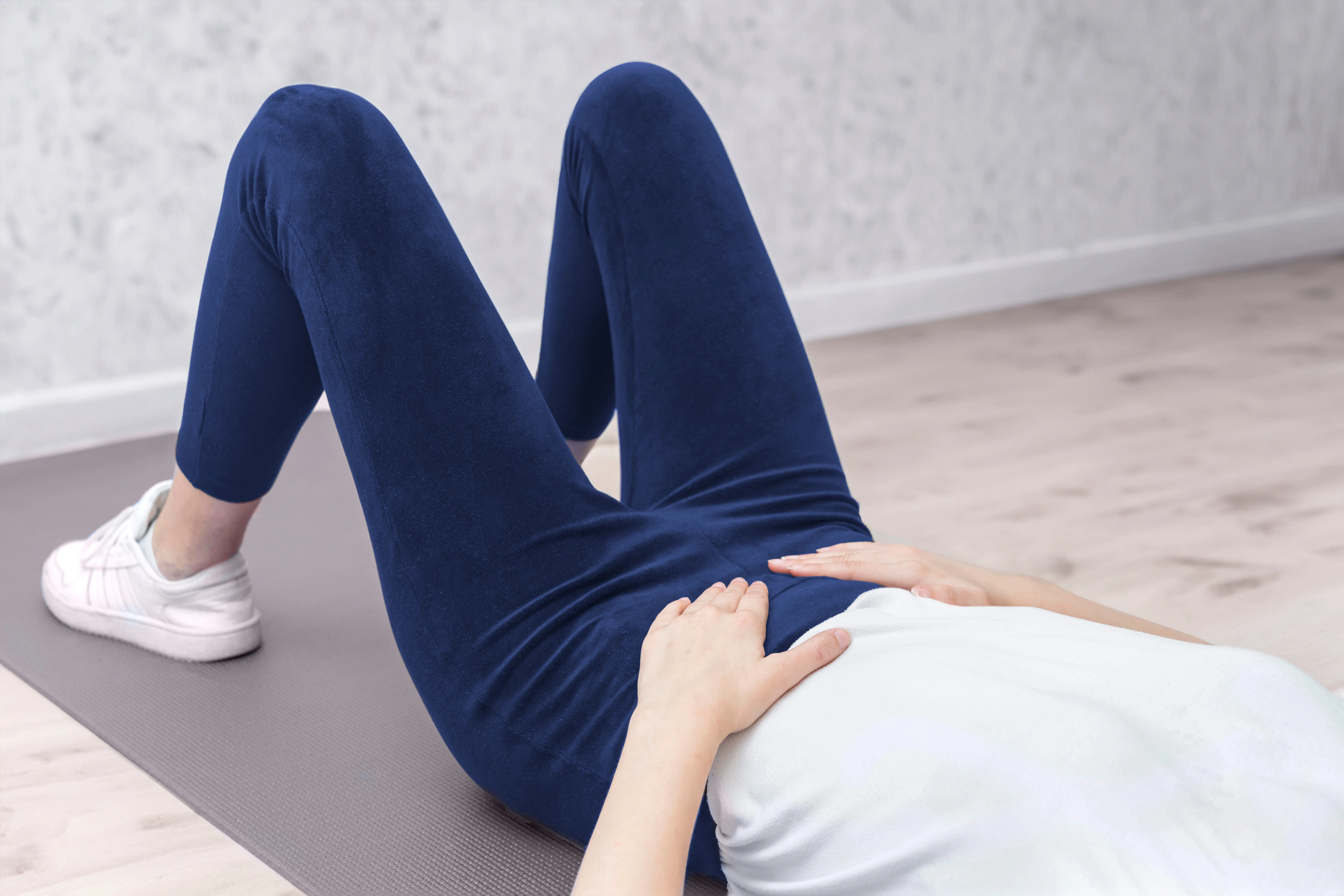
You'll want to do this lying on your back with your knees bent and feet flat on the floor.
Step 1: Find your landmarks.
Place your fingertips horizontally across your abdomen at the level of your navel. You're feeling for the edges of your rectus abdominis muscles, one on each side of the midline.
Step 2: Perform a gentle crunch.
Lift just your head and shoulders off the floor, as if you were doing a small crunch. This will cause your rectus muscles to contract, making them easier to feel.
Step 3: Feel for the gap.
As you're in that lifted position, press your fingertips gently into the midline. Notice: How many fingers fit side-by-side in the gap between the muscle bellies? Can you feel firm muscle on either side, or does it feel soft and unsupported in the middle?
Step 4: Check above and below the navel.
Repeat the check about 2-3 finger widths above and below the navel. DRA can be present in one area and not another, and the location matters for both symptom patterns and treatment.
Step 5: Notice for doming or coning.
As you lift your head and shoulders, look at your midline. Do you see a visible ridge or triangular peak forming? That is coning or doming, and it is a sign that intra-abdominal pressure is not being managed well through the midline, regardless of gap width.
What Your Results Mean
If you felt a gap of more than about 2 finger widths, or if you noticed doming: this is worth having evaluated by a pelvic floor PT. It doesn't mean something is catastrophically wrong, but it does mean your core system needs support.
If your gap felt narrow but the tissue felt soft and unsupported, or if you saw doming with a small gap: the gap measurement alone was never the right metric. This is functional DRA, and it's just as worth addressing.
If everything felt pretty normal but you're still experiencing symptoms (leaking, back pain, pelvic heaviness): the self-check isn't designed to catch everything. Come in and let me take a look.
What NOT to Do With This Information
Please don't start Googling exercise lists and immediately eliminating everything from your workout. The reflexive fear around DRA, particularly the warnings to avoid all crunches, sit-ups, and planks, is not supported by current evidence and leads to women under-loading their core for years out of fear.
The goal is not to avoid pressure. The goal is to rebuild your system's capacity to manage pressure well. That is a process, and it looks different for every body.
A self-check is a starting point for a conversation, not a treatment plan. And I'd love to have that conversation with you.
Ready to take the first step? Book your free consultation at https://app.pteverywhere.com/woven/bookingonline. Woven Pelvic Health and Wellness is located in Denver, CO and serves women throughout the Denver metro area.
Dr. Ashley Castellanos, PT, DPT is the owner and founder of Woven Pelvic Health and Wellness in Denver, Colorado. She specializes in pelvic floor physical therapy for women across all stages of life, with advanced training in manual therapy, dry needling, orthopedics, and trauma-informed care.

You may also like:



Your transformation begins with a single step
Not sure pelvic floor therapy is right for you? Let’s Talk! This complimentary consultation allows us to discuss your concerns, answer your questions, and determine if we’re the right fit for your healing journey.
Not sure pelvic floor therapy is right for you? Let’s Talk! This complimentary consultation allows us to discuss your concerns, answer your questions, and determine if we’re the right fit for your healing journey.